


|
|

Installing the SBus Adapter Hardware
You can install the single attachment SBus adapter in any SPARCstation or SPARCserver. The dual attachment adapter requires two adjacent SBus slots. This chapter describes how to install the SBus adapter in Sun workstations and servers:
This chapter also discusses how to identify SBus slots in each workstation, how to decide which SBus slot(s) to use, and how to properly install SBus adapters.
To install the SBus adapter, make sure that you complete the following procedures and have the required tools available:
The remainder of this chapter describes these procedures in detail.
Halt and Power Down the SPARCstation
Before you install the SBus adapter, halt and power down the SPARCstation.
To halt the system, take the following steps:
For additional information about halting your system, refer to the manual for your workstation.
SBus adapter faceplates have two different alignment schemes. One scheme is designed to fit under two hooks in the workstation back panel. Another design fits two tabs into slots in the top of the backpanel opening.
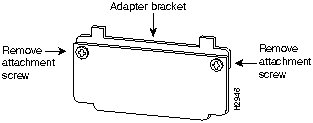
In the following procedures you will be told to remove the sheet-metal protector plate from the inner back panel of your workstation. If the removed protector plate does not have two alignment tabs on the top, you will need to remove the tab adapter bracket from the SBus adapter faceplate. Figure 4-1 shows the adapter faceplate tab bracket.
Figure 4-1 : Adapter Faceplate Tab Bracket Removal
To remove the adapter bracket, remove the two attachment screws shown in Figure 4-1. Now your SBus adapter faceplate will fit under the two hooks in your workstation back panel.
Save the adapter faceplate tab adapter bracket and screws in case you need to use them when installing the SBus adapter in other systems.
Installing the SBus Adapter in Your System
This section explains how to install the SBus adapter in a SPARCstation or SPARCserver.
Connecting to a Bypass Switch (FDDI Only)
The FDDI SBus dual attachment adapter has a connector for an optical bypass switch. The six-pin mini-DIN connector is compatible with most optical bypass switches. See the appendix, "Cabling and Pinout Information," for bypass connector pinout information.
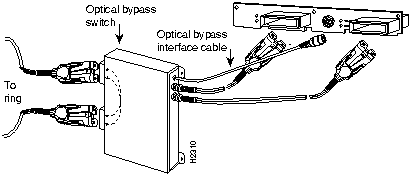
You can connect an optical bypass switch to the adapter to maintain connectivity to the FDDI ring. If a station enters a fault condition or is powered down or rebooted, the ring will not wrap if a bypass switch is present on the faulty station. When activated, a bypass switch removes a nonfunctioning dual attachment adapter from the ring.
The following figure shows how the bypass switch connects to the network and adapters.
Figure 4-2 : Connecting a Bypass Switch
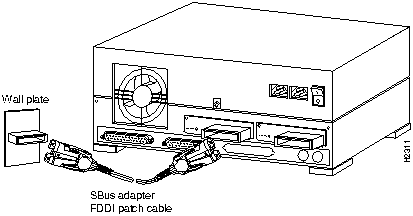
If you have an FDDI adapter, connect it to the network as follows:
Figure 4-3 : MIC Cable Connected to the SBus Adapter and Wall Plate
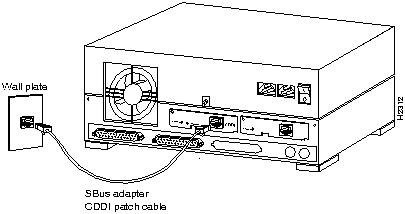
If you have a CDDI SBus adapter, connect it to the network as follows:
Figure 4-4 : RJ-45 Connector Connected to the SBus Adapter
To start up the system, turn ON the power switches in the following order:
To verify proper operation of the SBus adapter, apply power to the workstation and check the adapter LEDs.
The status LED shows the adapter's status. If this LED is on, the adapter has passed its internal diagnostics. This LED must be on for the adapter to function properly.
If the LED is not on, the SBus adapter has failed a critical diagnostic self-test. Run the FDDI status utility (see the appendix "Using the FDDI Status Utility") to determine the cause of the failure, and call the Cisco Technical Assistance Center.
Verify connection to the CDDI/FDDI ring by observing the ringop LED.
In a single attachment configuration the ringop LED monitors ring operation. If this LED is on, the adapter is connected to the CDDI/FDDI ring.
In a dual attachment configuration, the ringop LEDs on the dual attachment board work together to provide a visual indication of the state of your network. The ringop LED information in Table 4-1 will help you determine if your network is functioning properly.
Table 4-1 : Ringop LED Indicators
Copyright 1988-1996 © Cisco Systems Inc.

commands
:
/etc/halt
/etc/fasthalt



Ringop B1 Off
Ringop B1 Green
Ringop B1 Orange
Ringop A2
Off
Ring is not operational.
Station is in WRAP_B. Ring is an operational SAS. RING A is not a connected DAS.
Ring is not operational. The station connected to PHY B is attempting to connect, but has failed.
Ringop A2 Green
Station is in WRAP_A. RING B is not connected.
Station is in THRU mode. Ring is operational.
Station is in WRAP_A. The station connected to PHY B is attempting to connect, but has failed.
Ringop A2 Orange
Ring is not operational. Station connected to PHY A is attempting to connect, but has failed.
Station is in WRAP_B. Station connected to PHY A is attempting to connect, but has failed. This is normal if the station is dual homed.
Ring is not operational. Stations connected to PHY A and PHY B are attempting to connect, but have failed.
1 Ringop B refers to the ringop LED on the single attachment adapter or the right ringop LED on the dual attachment adapter.
2 Ringop A refers to the ringop LED on the dual attachment option or the left ringop LED on the dual attachment adapter.
