


|
|

The FastHub 116T is a 100Base-T compatible, standalone, 16-port, unmanaged Class II repeater supporting the 100Base-TX physical layer.
Figure 1-1 FastHub 116T Repeater
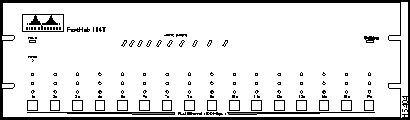
The FastHub 116T can be used to create Power Workgroups, facilitate high-density switch aggregation, or interconnect centrally located servers.
The FastHub 116T operates in a manner similar to that of a standard 10Base-T repeater. A packet received on any one of the 16 Fast Ethernet ports is transmitted, or repeated, out the other 15 ports. Visual indicators provide a measure of activity in Megabits per second, (Mbps), the FastHub 116T collision rate, and per port Link, Receive and Disabled status.
The FastHub 116T provides the following key features:
The FastHub front panel contains all of the network connectors and LEDs for easy access.
Figure 1-2 FastHub 116T Front Panel
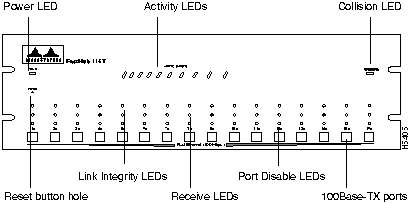
FastHub 116T features are described in the following sections.
The 16100Base-TX ports provide 100 Mbps of bandwidth for connection to a server or workstation, Cisco Systems Catalyst 1700, or other 100Base-TX hub. 100Base-TX ports are shown in Figure 1-3 below.
Figure 1-3 The FastHub 116T Fast Ethernet Ports
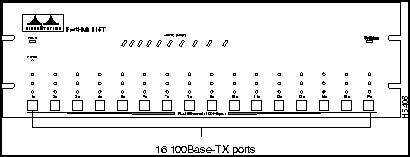
These ports support direct connection to any 100Base-TX compatible hub or adapter using UTP Category 5 cabling.
FastHub 116T has a comprehensive set of LEDs that allow easy and fast troubleshooting. The FastHub 116T has a Power LED, Activity Meter LEDs, and Status LEDs. These LEDs are shown in Figure 1-4 and described in the following section.
Figure 1-4 The FastHub 116T LEDs
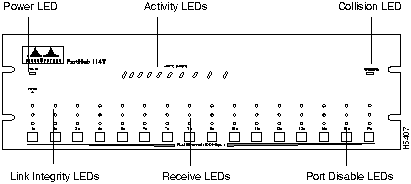
The Power LED lights if the FastHub 116T is turned on. If the LED does not light when powered up, refer to the "Troubleshooting" chapter.
Link LEDs provide an indication that an external port is connected to a functioning 100Base-TX link. This LED remains OFF until energy is detected on the cable and the contents of the energy pass the 100Base-TX link monitor function. Once a link has been established and the link LED is ON, any improper activity causes the link LED to blink OFF. The link LED will stay OFF if the port shows signs of being disconnected.
Receive activity on each port is indicated by the Receive LEDs. The Receive LEDs blink upon packet receipt regardless of the status of the port---even if the port is disabled.
The Disabled LED is OFF unless a jabber or autopartition error (as defined in the IEEE 802.3 100Base-T specification) is detected, in which case, the LED blinks ON. There is one disabled LED per port.
A jabber condition is sensed when a port continuously receives for more than 660 microseconds. A port is partitioned when it experiences 63 consecutive collisions.
The Collision LED provides a single visual indication of the frequency of collisions for all 16 ports. Packets received simultaneously on two or more ports will result in a collision.
The Activity Meter LED helps you measure the bandwidth utilization of the FastHub 116T at a glance. The meter displays current bandwidth activity.
The LEDs are updated based on the activity as measured in Mbps. The measurement is averaged over a period of 100 milliseconds.
Table 1-1 shows the associated bandwidth for each of the 10 LEDs.
Table 1-1 Activity Meter LED Information
| LED | Mbps Activity |
| Left | 1+ |
| 5+ | |
| 10+ | |
| 15+ | |
| 20+ | |
| 25+ | |
| 35+ | |
| 50+ | |
| 75+ | |
| Right | 100 |
The reset button restarts the FastHub 116T. The reset switch has the same effect as powering the FastHub 116T off and on and can be activated by pushing a thin implement into the hole.
The power switch, power receptacle, and fuse are located on the rear panel as shown in Figure 1-5 below.
Figure 1-5 The FastHub 116T Rear Panel
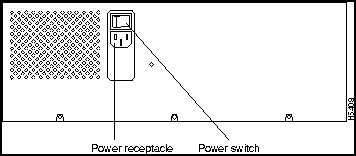
The power switch is depicted in Figure 1-5 and turns the FastHub 116T on and off without removing the power cord.
The FastHub power supply is an auto-ranging unit supporting input voltages between 100-220 VAC. The power cord should be plugged into the power receptacle located on the rear panel of the FastHub 116T as shown in Figure 1-5.
The fuse is located under the power receptacle. For replacement, use a 3-amp, 250-volt fuse only.

|
Copyright 1988-1996 © Cisco Systems Inc.