Table of Contents
Cisco 2000 to Cisco 3000 Functionality Upgrade
Cisco 2000 to Cisco 3000 Functionality Upgrade
Cisco Part Numbers: MEMOP,2202,1R1T,FLASH UPGD, MEMOP,2102,1E1T,FLASH UPGR
This publication is intended for the technician, engineer, or system administrator responsible for upgrading a Cisco 2000 system to Cisco 3000 functionality.
This publication contains the following:
- Installation Prerequisites, page 1
- Tools and Equipment, page 2
- General Safety, page 3
- Safety with Electricity, page 3
- Opening the Chassis, page 4
- Removing the Chassis Cover, page 4
- Removing the Power Supply Tray, page 6
- Upgrading Your System, page 6
- Replacing the Cover and Tray, page 11
- Checking the Upgraded System, page 12
Successful use of Flash memory requires that the following conditions be satisfied.
- Your router must have a minimum of 4 MB of DRAM to function with Flash memory. If your system has less than 4 MB of DRAM, then you must first install the DRAM memory upgrade, MEM-2C4M= or MEM-2C16M=. The publication 78-1182-01, Upgrading Cisco 2000 Memory, explains the memory upgrade procedure and ships with the memory upgrade kits: MEM-2C4M= or MEM-2C16M=. The publication 78-0953-02, Cisco 3000 Hardware Installation and Maintenance, which describes the Flash memory features of your upgraded router, is also orderable.
- A Trivial File Transfer Protocol (TFTP) file service must be available, with the desired system software image---Version 9.1 or later (See Table 1.)---available on the TFTP file server. These files can then be downloaded into the Flash memory using TFTP. Consult with your network administrator regarding availability. The system will not be fully functional without the system software and running configuration. Consult the appropriate system software publication for TFTP procedures.
Note One upgraded router can serve as a TFTP server for other upgraded routers.
- The words flash and rom are reserved for the boot system and no boot system configuration commands. They indicate that the Flash memory or system ROM, respectively, are to be used for booting system images. Do not use these reserved words for other files you create.
System software will also be provided separately from this upgrade kit. After the upgrade, any references to system software in the Cisco 3000 indicates your router. Table 1 lists the minimum system software version required after the upgrade.
Table 1 Minimum System Software Version
| 3202 (was 2202) |
SW-GF-9.1.8= |
SF-GF-9.1.8= |
| 3102 (was 2102) |
SW-G3-9.1.8= |
SF-G3-9.1.8= |
The two versions of the Cisco 2000 to Cisco 3000 functionality upgrade kits are as follows:
- For model 2202 (Token Ring) the upgrade kit, Product Number MEMOP,2202,1R1T,FLASH UPGD, contains the following:
- Eight Flash erasable programmable read-only memory (EPROM) components
- Two boot ROMs
- One integrated circuit component labeled either 77-1057-01 or 1R1T
- One 5 VDC to 12 VDC converter
- For model 2102 (Ethernet) the upgrade kit, Product Number MEMOP,2102,1E1T,FLASH UPGR, contains the following:
- One or Two Flash memory Single In-line Memory Modules (SIMMs)
- Two boot ROMs
- One integrated circuit component labeled 77-1005-01 or 1E1T
- One 5 VDC to 12 VDC converter
For these procedures, you will need the following tools and equipment:
- ESD cord and wrist strap
- EPROM removal tool
- No. 1 Phillips screwdriver
To ensure general safety, follow these guidelines:
- Keep the area of the chassis clear and dust-free during and after installation.
- Put removed chassis covers in a safe place and keep tools away from walk areas where you or others could trip over them.
- Do not wear loose clothing or other items that could get caught in the chassis; fasten your tie or scarf and sleeves.
- Wear safety glasses when working under conditions that might be hazardous to your eyes.
- Do not perform any action that creates a potential hazard to people or makes the equipment unsafe.

Warning Hazardous voltages may exist in or near the power supply, so use extreme caution when working with the power supply. Remove rings, watches, and any other jewelry before working on equipment that is connected to power lines. Metal objects will heat up when connected to power and ground and the metal object can weld to a terminal or cause serious burns.
Follow these guidelines when working on equipment powered by electricity:
- Locate the emergency power-off switch for the room in which you are working, so if an electrical accident occurs, you can act quickly.
- Disconnect all power before doing the following:
- Installing or removing a chassis
- Working near power supplies
- Performing a software upgrade
- Before working on the system, turn off the power and unplug the power cord.
- Never assume that power is disconnected from a circuit; always check.
- Do not work alone if potentially hazardous conditions exist.
- Carefully examine your work area for possible hazards, such as moist floors, ungrounded power extension cables, power surges, and missing safety grounds.
- If an electrical accident occurs, do the following:
- Use caution; do not become a victim yourself.
- Turn off power to the system.
- If possible, send another person to get medical aid. Otherwise, assess the victim's condition and then call for help.
- Determine if the person needs rescue breathing and/or external cardiac compressions; then take appropriate action.
When electronic components are improperly handled, electrostatic discharge (ESD) can damage equipment and impair electrical circuitry, and can result in complete or intermittent failures.
Always follow ESD prevention procedures when removing and replacing components. Wear an ESD wrist strap, ensuring that it makes good skin contact. Connect the clip to an unpainted chassis frame surface to safely channel unwanted ESD voltages to ground. To properly guard against ESD damage and shocks, the wrist strap and cord must operate effectively.
This section outlines the steps required to open the Cisco 2000 chassis. The following discussion assumes that you are looking at the Cisco 2000 from the front. Use Figure 1 as a guide when removing the cover and power supply tray.
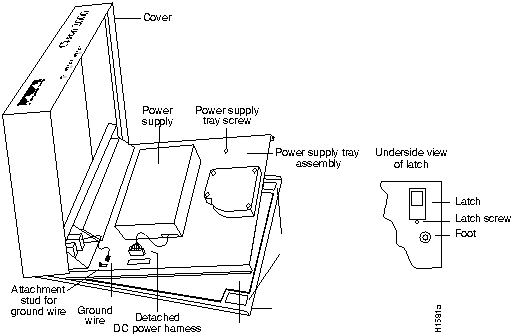
Figure 1 Internal View of the Cisco 2000

Warning To prevent damage to the electrical components, before opening the chassis, be sure you have discharged all static electricity from your body, as discussed in the section, "Preventing Electrostatic Discharge Damage." Ensure that the power cord has been disconnected for your safety.
To remove the Cisco 2000 cover, follow these steps:
- Step 1 Turn OFF the unit and unplug it.
- Step 2 Remove all cables from the back of the Cisco 2000 (including the power cable) to ensure that the unit is not powered on and that the cover will not stick on the cables. Failure to remove all the cables can result in damage to the LAN and WAN connectors at the rear of the unit.
- Step 3 Turn the unit upside down so that the top of the chassis is resting on a surface and the front of the chassis is facing you, taking care not to damage the LAN or WAN connectors.
- Step 4 Remove the latch screw behind the latch on the right underside of the chassis. (See Figure 1.) The latch will not open until this screw is removed.
- Step 5 Turn the unit right side up with the LEDs facing you. Place your fingers inside the two front latches on the underside of the chassis (see the underside view in Figure 1) and push the latches away from you until they snap open.
- Step 6 Lift the chassis cover from the front edge where the LEDs are located. The chassis cover will tilt up from the front toward the back. If you feel excessive resistance when opening the unit, one of the latches might still be closed. Try pushing back on the latches again.
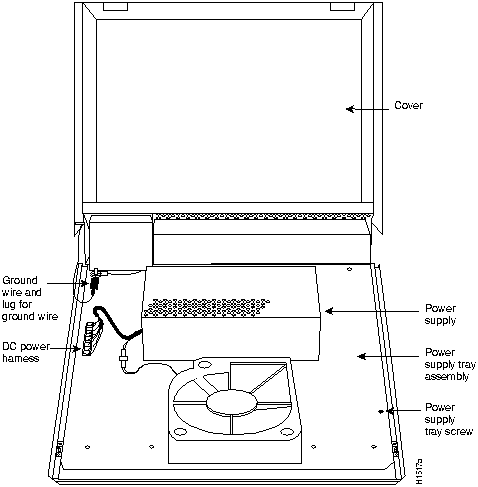
Figure 2 Cisco 2000 Tray Assembly
- Step 7 Remove the ground wire (green with yellow stripes) connecting the hinge post on the cover with the main ground stud, as shown in Figure 2. The ground wire is attached to the main ground stud with a slip-on lug, so the wire can be slipped off easily.
- Step 8 Remove the chassis cover the rest of the way by pulling it up and forward so that the hinge posts come free from the notches in the bottom tray.
- Step 9 Set the cover aside.
To remove the Cisco 2000 power supply tray assembly, follow these steps:
- Step 1 Locate the DC power harness on the far left edge of the power supply tray assembly, as shown in Figure 2. Using the pull tab provided, detach the DC power harness from the system card under the power supply tray assembly.
 Caution Lifting the power supply tray assembly without removing this harness, might damage the cable that provides all the power to the system card.
- Step 2 Remove the power supply tray screw (safety ground screw), which is located near the right front top corner of the power supply tray assembly. (See Figure 2.)
Note The power supply tray screw that holds down the power supply tray assembly is not obvious. This screw must be removed before the power supply tray assembly can be removed.
- Step 3 Place your fingers underneath the front edge of the power supply tray assembly and pull the edge up while holding the base down. The latches holding the power supply tray assembly will release.
- Step 4 Slide the power supply tray assembly toward you, lift it off the bottom, and remove it. The system card is now exposed. You do not need to remove the system card from the bottom of the chassis.
- Step 5 Set the power supply tray assembly aside.
If you are upgrading a Cisco 2000 system with a Token Ring port (model 2202), proceed to "Upgrading Systems with a Token Ring Port."
If you are upgrading a Cisco 2000 system with an Ethernet port (model 2102), proceed to "Upgrading Systems with an Ethernet Port."
After exposing the system card, follow these steps to upgrade your model 2202 to a model 3202.
Figure 3 illustrates the 2202 card layout. The card is oriented with the front panel LEDs at the bottom of the illustration. Refer to Figure 3 to locate the components on the system card. Note the notches shown on the Flash EPROM, DC/DC converter, and boot ROM components.
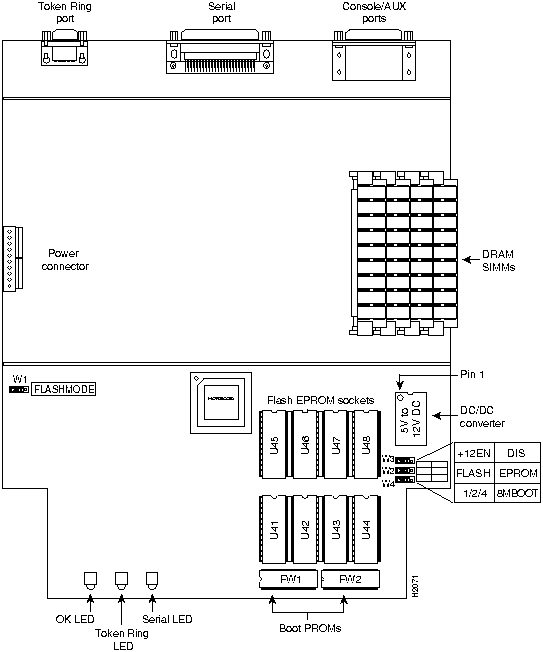
Figure 3 Cisco 2202 with Token Ring Card Layout

Caution Notches on the components match the notches on the sockets on the card. Installing the components backward will damage them.
- Step 1 Install boot ROM 17-1313-03 in location FW1, aligning the notch on the component with the notch on the end of the socket.
- Step 1 Install boot ROM 17-1314-03 in location FW2, aligning the notch on the component with the notch on the end of the socket.
- Step 2 Locate the EPROMs labeled U41 through U48 at the front of the unit. (See Figure 3.)
- Step 3 Use an EPROM removal tool to gently remove EPROMs at locations U41 through U48 and be sure to keep the old EPROMs separate from the new ones to avoid mixing the two sets.
- Step 4 Insert the Flash EPROMs in sockets U41 through U48 (see Figure 3), being careful not to bend or crush any of the pins. To straighten a bent pin, use needle-nose pliers. Align the notch in the Flash EPROM with the notch in the socket. Be careful not to damage or scratch the printed circuit card under the EPROMs.
- Step 5 Install the DC/DC converter (labeled 5V to 12V DC) at location U142, aligning the notch on the component with the notch on the end of the socket.
- Step 6 Replace the integrated circuit component labeled BUD-1R1T at location U169 with the new component labeled 1R1T or 77-1057-01, aligning the notch on the component with the notch on the end of the socket.
- Step 7 Select the proper jumper configurations at jumper locations W1, W2, W3, and W4. The jumper settings should be as shown in Table 2 and Figure 3.
Note The jumper ordering (first W3, then W2, then W4) is not intuitive.
Table 2 Model 3202 (Was 2202) Jumper Settings
| W1 |
Pin 2 to 3 |
Pin 1 to 2 |
| W2 |
Pin 2 to 3 |
Pin 1 to 2 |
| W3 |
Pin 2 to 3 |
Pin 1 to 2 |
| W4 |
Pin 1 to 2 |
Pin 1 to 2 |
- Step 8 Proceed to "Replacing the Cover and Tray."
After exposing the system card, follow these steps to upgrade your model 2102 to a model 3102.
Figure 4 illustrates the 2102 card layout. The card is oriented with the front panel LEDs at the bottom of the illustration. Refer to Figure 4 to locate the components on the system card.
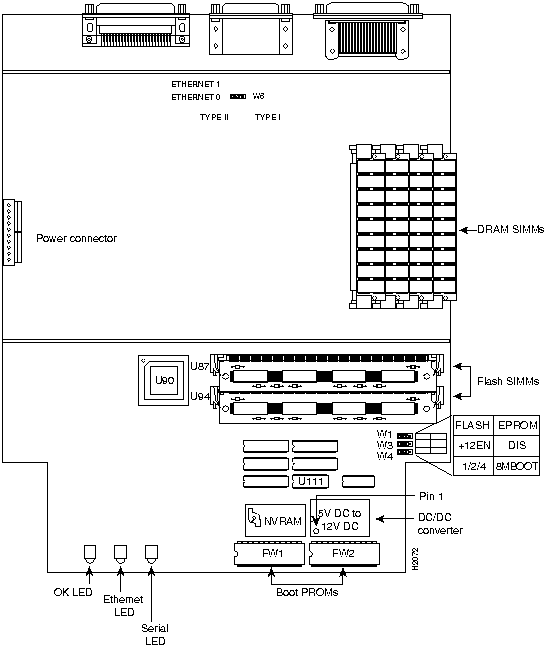
Figure 4 Cisco 2102 with an Ethernet Port Card Layout

Caution Notches on the components match the notches on the sockets on the card. Installing the components backward will damage them.
- Step 1 Install the boot ROM labeled 17-1311-03 in location FW1, aligning the notch on the component with the notch on the end of the socket.
- Step 2 Install the boot ROM labeled 17-1312-03 in location FW2, aligning the notch on the component with the notch on the end of the socket.
- Step 3 Locate the SIMMs containing plastic-leaded chip carriers (PLCCs) on the system card at locations U87 and U94. (See Figure 4.)
- Step 4 Remove the PLCC SIMMs by lightly squeezing the connector clips to unlatch them as shown in Figure 5. Be careful not to break the clips on the SIMM connector.
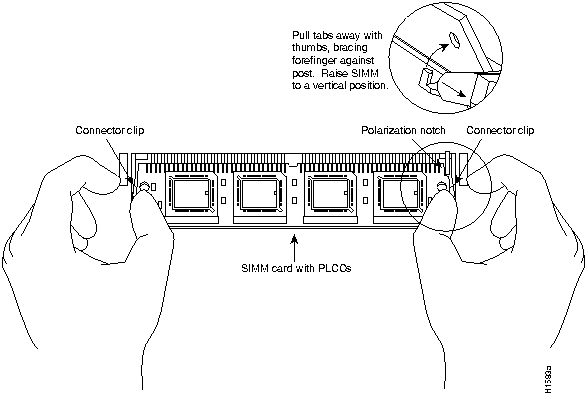
Figure 5 Removing SIMMs Containing PLCC Components
- Step 5 Select the proper jumper configurations at jumper locations W1, W2, W3, and W4. The jumper settings should be as shown in Table 3 and Figure 4. These new settings permit writing to Flash memory.
Table 3 Model 3102 (Was 2102) Jumper Settings
| W1 |
Pin 2 to 3 |
Pin 1 to 2 |
| W3 |
Pin 2 to 3 |
Pin 1 to 2 |
| W4 |
Pin 1 to 2 |
Pin 1 to 2 |
- Step 6 Align the polarization notch on the SIMM with the polarization notch on the system card and insert the new Flash memory SIMM into the connector labeled U94 (see Figure 4 and Figure 5), sliding the end with the metal fingers straight down into the SIMM connector socket, at an angle perpendicular to the card.
- Step 7 While keeping a gentle downward pressure, gently rock the SIMM back toward the system card and snap into place. (See Figure 5.) Do not use excessive force, because the connector could break.
- Step 8 Repeat steps 5 and 6 for the second new Flash memory SIMM, inserting it into the connector labeled U87.
- Step 9 Remove the integrated circuit component labeled BUD-1E1T at location U111.
- Step 10 Install the new integrated circuit component labeled either 1E1T or 77-1005-01 at location U111, aligning the notch on the component with the notch on the end of the socket.
- Step 11 Install the DC/DC converter (labeled 5V to 12V DC) at location U118, aligning the notch on the component with the notch on the end of the socket.
- Step 12 Proceed to "Replacing the Cover and Tray."
After you have replaced the EPROMs or PROMs for your system, replace the cover and tray by following these steps while referring to Figure 1 and Figure 2:
- Step 1 Replace the metal tray on the chassis.
- Step 2 Replace the ground wire.
- Step 3 Replace the DC power harness.
- Step 4 Replace the power supply tray screw (safety ground screw).
- Step 5 Replace the chassis cover, sliding it in at an angle and then pushing down on it.
- Step 6 Replace the latch screw.
- Step 7 Replace the network cables.
- Step 8 Replace the power cable.
Note The power cable is designed so that if it is installed backward or offset, +5V is shorted to ground. This enables the protective circuitry on the power supply to protect the system card from reversed voltage. If this happens, you will hear a quiet clicking from the power supply and you will not hear other noises, such as the fan, and no LEDs will light.
- Step 9 Proceed to "Checking the Upgraded System."
To test the upgraded system, connect it to a console terminal, and turn on the power. The OK LED on the front of the chassis should light, and your system will go through the bootup procedures. The router prompt displayed on the console terminal will be the boot ROM prompt as follows:
router(boot)>
If your router fails to boot correctly, proceed to "If Your Token Ring (Model 3202) System Fails to Boot Properly" or "If Your Ethernet (Model 3102) System Fails to Boot Properly."
Use the copy tftp filename command to copy a new system software image to your Flash memory.
Refer to the router software publications for more information on the copy tftp command.
If you insert one or more of the EPROMs incorrectly in the model 3202 router, the system will not boot properly. If this happens, do the following:
- Step 1 Turn OFF the power.
- Step 2 Reopen the chassis to the system card.
- Step 3 Locate the offending EPROM, straighten its pins, then reinsert it.
- Step 4 Verify that the boot ROMs labeled FW1 and FW2 are in the correct positions.
- Step 5 Reassemble the chassis.
- Step 6 Turn ON the power to test it again.
- Step 7 When the system tests successfully, follow your software manual's instructions for rebooting the system and loading a new system software image into Flash memory.
If you insert one or more of the Flash SIMMs incorrectly in the model 3102 router, the system will not boot properly. If this happens, do the following:
- Step 1 Turn OFF the power.
- Step 2 Reopen the chassis to the system card.
- Step 3 Locate the offending SIMM and reinsert it into its socket.
- Step 4 Verify that the boot ROMs labeled FW1 and FW2 are in the correct positions.
- Step 5 Reassemble the chassis.
- Step 6 Turn ON the power to test it again.
- Step 7 When the system tests successfully, follow your software manual's instructions for rebooting the system and loading a new system software image into Flash memory.

Copyright 1988-1995
©
Cisco Systems Inc.



