


|
|

The Cisco 7505 router is a part of the Cisco 7500 series, and is a five-slot multiprotocol, multimedia router/bridge. Network interfaces reside on interface processors, which provide a direct connection between the Cisco Extended Bus (CyBus) and external networks.
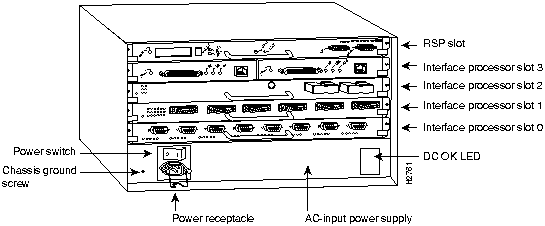
The Cisco 7505 has five slots: four interface processor slots (0 through 3) and one slot for the Route Switch Processor (RSP1). The Cisco 7505 uses a single power supply, with two models available: DC input or AC input.
Figure 1-1 shows the interface-processor end of the Cisco 7505 (with an AC-input power supply installed).
Figure 1-1 Cisco 7505, Rear View
Following is a list of acronyms that identify the system components and features:
Table 1-1 lists the specifications for the Cisco 7505 system.
Table 1-1 Cisco 7505 Specifications
| Description | Specification |
|---|---|
| High-speed backplane | 1.067-gigabits per second (Gbps) CyBus, 4 interface processor slots, and 1 RSP1 slot |
| Dimensions (H x W x D) | 10.5 x 17.5 x 17.0'' (26.67 x 44.45 x 43.18 cm)Chassis depth including power cord and cable management brackets is 19'' (48.26 cm) |
| Weight | Chassis only (including power supply and fan array): 46 lb (20.87 kg)Chassis fully configured with 1 RSP1 and 4 interface processors: 70 lb (31.75 kg) |
| Power dissipation | 600W maximum configuration with AC-input power supply600W maximum configuration with DC-input power supply |
| Heat dissipation | 715W (2440 British thermal units [Btus]/hr) |
| Power distribution | 75 amps (A) maximum @ +5 VDC, 15A maximum @ +12 VDC, 3A maximum @ --12 VDC, 5A maximum @ +24 VDC |
| AC-input rating | 100 to 240 volts AC (VAC), wide input with power factor corrector (PFC); 9A maximum @ 100 VAC, 4A maximum @ 240 VAC (at 600W) |
| Frequency | 50 to 60 Hz |
| DC-input rating | --40 volts DC (VDC) minimum in North America (--56 VDC in European Community)--48 VDC nominal in North America (--60 VDC in European Community)--52 VDC maximum in North America (--72 VDC in European Community)20A maximum at --48 VDC and 16A maximum @ --60 VDC |
| DC-input cable | 10 AWG (American Wire Gauge); recommended minimum wire gauge (you provide) |
| DC-input hold-up time | 10 milliseconds (ms) of output after the DC input has been interrupted |
| Airflow | Side-to-side through the chassis using a variable-speed, 6-fan array |
| Temperature | 32 to 104°F (0 to 40°C), operating; --4 to 149°F (--20 to 65°C), nonoperating |
| Humidity | 10 to 90%, noncondensing |
| Agency approvals |
Safety: UL 1950, CSA 22.2-No. 950, EN60950, EN41003, AUSTEL TS001, AS/NZS 3260, IEC 801-2, 3, 4, 5, and 6EMI: FCC Class A, VCCI Class II, and CISPR 22 B (EN 55022) Conducted Emissions |
Figure 1-2 shows the chassis fan array and airflow in the Cisco 7505.
Figure 1-2 Cisco 7505 Fan Array and Airflow
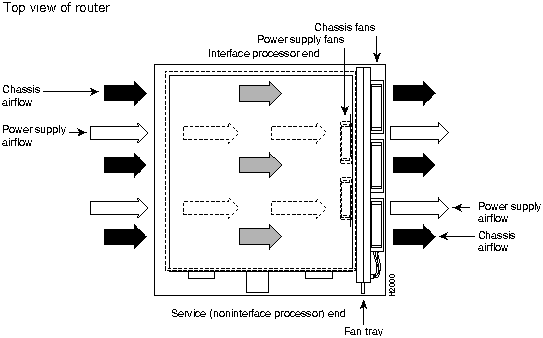
Six individual axial fans draw cooling air through the chassis interior to maintain an acceptable temperature for the internal components. The fans draw air in through the inlet vents on the side of the chassis opposite the fans, across the processor modules and other internal components, and through the exhaust vents adjacent to the fans.
The sides of the chassis must remain unobstructed to ensure adequate airflow and prevent overheating inside the chassis. A temperature sensor on the RSP1 monitors the internal air temperature. The power supply has two fans for cooling.
For complete information on fan operation and environmental considerations related to fan speed, refer to the Cisco 7505 Hardware Installation and Maintenance publication. For information on ordering printed documentation or Cisco Connection Documentation CD-ROM, refer to the section "If You Need More Configuration Information," in the chapter "Performing a Basic Configuration of the Cisco 7505."

|
Copyright 1988-1996 © Cisco Systems Inc.