


|
|

CiscoWorks Windows is a suite of integrated PC-based network configuration and diagnostic tools for small to medium-sized networks or remote workgroups.
This chapter contains the following sections on CiscoWorks Windows applications and features:
The CiscoWorks Windows Show Commands and Health Monitor applications can only run under HP OpenView or CastleRock SNMPc. Configuration Builder and CiscoView can run as standalone applications or within the HP OpenView or SNMPc platforms.
With Configuration Builder, you can create configuration files for multiple Cisco routers, access servers, hubs and devices without having to remember complicated command-line syntax for the devices. Using Configuration Builder, you can configure Cisco devices with the most common Cisco IOS features. See Tables 2-2 through 2-6 for a brief overview of supported Cisco IOS features.
Configuration Builder provides the following special features:
Configuration Builder generates and stores the following files in the \data directory:
| *.cdf | configuration files (binary) |
| *.cfg | configuration files (text) |
| *.cbk | configuration backup files |
| snmphost.chl | SNMP host names file |
| zones.apt | AppleTalk zones file |
Configuration Builder generates and stores the following files in the \data\snapin directory:
| *.aal | AppleTalk access lists |
| *.ial | IP access lists |
| *.nal | IPX access lists |
| *.nsl | IPX SAP filter lists |
| *.pql | Priority queuing lists |
The \data\srb directory contains files with the extension *.srb. These files define remote source-route bridging (SRB) groups.
The \data\sdlc directory contains files with the extension *.s. These files define SDLC tunnel groups.
Configuration Builder Main Window
The Configuration Builder main window is illustrated in Figure 2-1. The number and types of network icons displayed in the main window will vary according to your network configuration.
Figure 2-1 : Configuration Builder Main Window
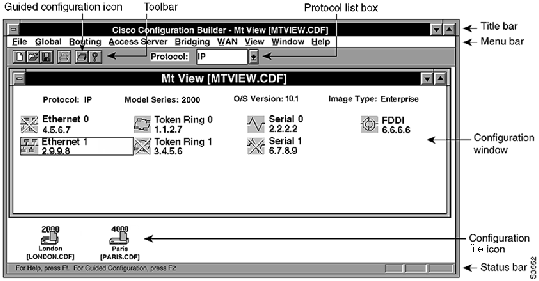
The Configuration Builder main window consists of the following elements:
Table 2-1 : Configuration Builder File Menu Items
| Items | Explanation |
|---|---|
| New | Create a new configuration file |
| Open | Open an existing file |
| Close | Close an existing file |
| Save | Save changes to a file |
| Save Backup | Create a backup of a configuration file |
| Save As Text | Save a configuration file as a text file so it can be edited with a word processor or stored on a network server. |
| Delete | Delete a configuration file. |
| Communication Timeouts | Specify the timeouts to be used for data transfer from the Configuration Builder to the router. |
| Send | Send a configuration file to a local or remote router. |
| Print a configuration file. | |
| Print Setup | Set up printer parameters. |
| Exit | Exit Configuration Builder. |
Table 2-2 : Configuration Builder Global Menu Items
| Item | Explanation |
|---|---|
| Guided Configuration | Step through the guided configuration. |
| Basic | Set basic system parameters, including host names, passwords, and banner. |
| SNMP | Specify SNMP parameters for network management data, set community strings, and restrict SNMP access to the device. |
| Priority Queuing | Create new priority output queuing lists or import snap-in lists. |
| Modify Interfaces | Add or delete device interfaces and specify device type, software version, and image type. Specify device interfaces and lines. Change the sequence of the guided configuration. |
| Add Commands | Configure advanced features and features added in later Cisco IOS releases. |
| Hub | Enable hub configuration features. |
Table 2-3 : Configuration Builder Routing Menu Options
| Item | Explanation |
|---|---|
| IP:Configuration Routing Protocols Access Lists | Configure primary and secondary IP addresses.Configure Routing Information Protocol (RIP), Interior Gateway Routing Protocol (IGRP), and/or OSPF.Create new access lists or import snap-in lists. |
| AppleTalk:Configuration Distribute-Out Filters | Configure AppleTalk addresses, cable ranges, and zones.Create access lists for filtering AppleTalk packets. |
| IPX:ConfigurationAccess ListsSAP Filters | Configure IPX addresses.Create new access lists or import snap-in lists.Create new SAP filters or import snapin lists. |
Table 2-4 : Configuration Builder Access Server Menu Options
| Item | Explanation |
|---|---|
| Line Characteristics:Chat Script ManagerLine Configuration | Configure modem or login chat scripts.Configure line characteristics for TTY and auxiliary lines. |
| Remote Node:Extended BootP ManagerARALine Configuration | Configure an access server for BootP to allow Serial Line Internet Protocol (SLIP) and Point-to-Point Protocol (PPP) requests from clients. Configure AppleTalk Remote Access (ARA). Configure remote nodes for TTY and auxiliary lines. |
| Terminal Services:LAT ManagerXRemote ManagerLine Configuration | Configure Local Area Transport (LAT).Configure XRemote protocol. Configure terminal services for console, TTY, auxiliary, and virtual terminal lines. |
| Security:Local User Name ManagerTACACS ManagerLine Configuration | Assign usernames and passwords.Configure login method, line passwords, Point-to-Point PPP authentication, and assign IP access lists. Configure security for console, TTY, auxiliary, and virtual terminal lines. |
| Dial-on-Demand:Dialer Rotary GroupIPIPX | Configure the dialer rotary group. Configure DDR for IP.Configure DDR for IPX. |
| Protocol Translation | View configuration protocol translation features. |
Table 2-5 : Configuration Builder Bridging Menu Items
| Item | Explanation |
|---|---|
| Transparent Bridging:ConfigurationBridge Groups | Configure transparent bridging.Create bridge groups and set spanning-tree and circuit options. |
| Source-Route:SimpleRemote | Configure simple SRB options.Configure remote SRB options. Remote source-route bridging provides multiple router configuration capability. That is, equivalent statements in the configuration files of devices in the same virtual ring are automatically updated. |
| SR/TLB | Configure source-route translational bridging (SR/TLB). |
Table 2-6 : Configuration Builder WAN Menu Items
| Item | Explanation |
|---|---|
| Wide-Area Protocols | Configure wide-area network (WAN) protocols, including HighLevel Data Link Control (HDLC), PPP, X.25, Frame Relay, and Switched Multimegabit Data Service (SMDS). |
| Dial-on-Demand | Configure DDR destination subnet, subnet mask, telephone numbers, destination router IP address, and timers. |
| Dial Backup | Configure dial backup interfaces and delay options. |
| SDLC Transport | Configure devices for SDLC transport, a subset of serial tunneling (STUN). Provides multiple router configuration capability. That is, equivalent statements in the configuration files of other SDLC devices are automatically updated. |
Table 2-7 : Configuration Builder View Menu Items
| Item | Explanation |
|---|---|
| By Protocol | Display configuration commands grouped by protocol type. |
| By Interface | Display configuration commands grouped by interface. |
| Configuration | Display the configuration as a text file. |
| Toolbar | Display or hide the toolbar. |
| Status Bar | Display or hide the status bar. |
| Expert Mode | Select expert mode to enable an additional path for configuring global access server features. |
Table 2-8 : Configuration Builder Window Menu Items
| Item | Explanation |
|---|---|
| Cascade | Resize and layer windows so that each title bar is visible. |
| Tile | Resize and arrange windows side by side. |
| Arrange Icons | Arrange icons evenly. |
| file selection | Select a previously opened configuration file. |
Table 2-9 : Configuration Builder Help Menu Items
| Item | Explanation |
|---|---|
| Contents | Open the Configuration Builder help system table of contents. |
| Cisco Support Information | Find out how to contact Cisco Systems for product support and how to obtain additional documentation. |
| Using Help | Learn how to use the online help system. |
| About Configuration Builder | Display Configuration Builder software release and copyright information. |
With Show Commands, you can quickly display detailed system and protocol information for routers without having to remember complicated command-line syntax for each device. Launch Show Commands by clicking on the Show icon in the CiscoView toolbar.
You can display the following system information for devices:
The Show Commands main window is illustrated in Figure 2-2.
Figure 2-2 : Show Commands Main Window
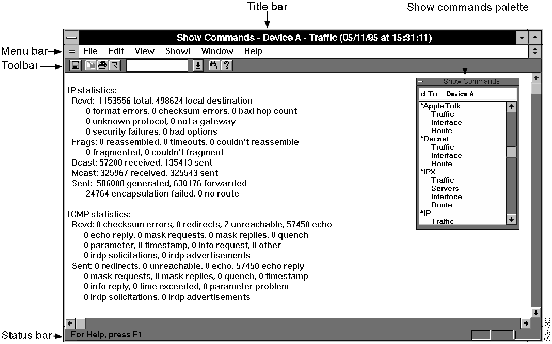
The Show Commands main window consists of the following elements:
Table 2-10 : Show Commands File Menu Items
| Item | Explanation |
|---|---|
| Close | Closes the Show Commands window. |
| Save | Save changes to a file. |
| Save As | Save Show Commands output to a new filename. |
| Connect | Connect to a specific device. |
| Send a Show Commands screen display to a printer. | |
| Print Preview | View the file before printing. Zoom in or out and scan pages. |
| Print Setup | Set printing options. |
| Exit | Exit the Show Commands application. |
Table 2-11 : Show Commands Edit Menu Items
| Item | Explanation |
|---|---|
| Copy | Copy text from an active window. |
| Select All | Select all text within an active window. |
| Find | Find a keyword within an active window. |
Table 2-12 : Show Commands View Menu Items
| Item | Explanation |
|---|---|
| Toolbar | Display or hide the toolbar. |
| Status Bar | Display or hide the status bar. |
| Show Command Palette | Display the Show Commands Palette floating window. |
Table 2-13 : Show Commands Show Menu Items
| Item | Explanation |
|---|---|
| Show! | Display the Show Commands window from which you can execute and display output from a specific show command. |
Table 2-14 : Show Commands Window Menu Items
| Item | Explanation |
|---|---|
| Cascade | Resize and layer windows so that each title bar is visible. |
| Tile | Resize and arrange windows side by side. |
| Arrange Icons | Arrange icons evenly. |
| Close All | Close all open Show Commands windows. |
| Refresh | Refresh the active Show Commands window. The time and date are updated. |
| window selection | Select a previously opened Show Commands window. |
Table 2-15 : Show Commands Help Menu Items
| Item | Explanation |
|---|---|
| Contents | Open the Show Commands help system table of contents. |
| Help for Current Show Command | Open the help window specific to the active show command window. |
| Cisco Support Information | Find out how to contact Cisco Systems for product support and how to obtain additional documentation. |
| Using Help | Learn how to use the online help system. |
| About Show Commands | Display Show Commands software release and copyright information. |
Health Monitor is a dynamic fault and performance management tool that provides real-time statistics on device characteristics, interface status and utilization, and protocol utilization. Launch Health Monitor by clicking on the Health Monitor icon in the CiscoView toolbar.
With Health Monitor, you can customize feedback on device and interface status with settings in the Preferences dialog box:
Health Monitor provides the following device and interface information:
The Health Monitor main window is illustrated in Figure 2-3.
Figure 2-3 : Health Monitor Main Window
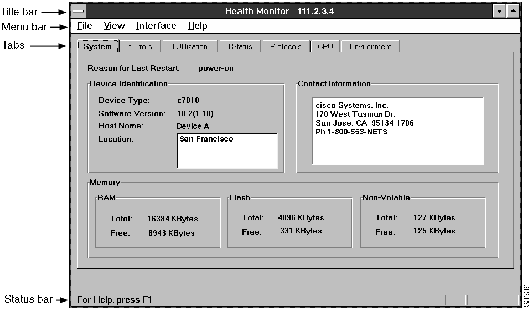
The Health Monitor main window consists of the following elements:
Table 2-16 : Health Monitor File Menu Items
| Item | Explanation |
|---|---|
| Connect | Connect to a specific device. |
| Preferences | Set the threshold value, interface sorting, polling frequency, and timeout preferences. |
| Exit | Exit the Health Monitor application. |
Table 2-17 : Health Monitor View Menu Items
| Item | Explanation |
|---|---|
| Status Bar | Display or hide the status bar. |
Table 2-18 : Health Monitor Interface Menu Items
| Item | Explanation |
|---|---|
| Utilization | View interface utilization. |
| Protocols | Determine interface protocol usage. |
| Errors | View interface error rates. |
| Show | View show interface command statistics for an interface. |
Table 2-19 : Health Monitor Help Menu Items
| Item | Explanation |
|---|---|
| Contents | Open the Health Monitor help system table of contents. |
| Help on Current Tab | Open the help window specific to the active Health Monitor tab. |
| Cisco Support Information | Find out how to contact Cisco Systems for product support and how to obtain additional documentation. |
| Using Help | Learn how to use the online help system. |
| About Health Monitor | Display Health Monitor software release and copyright information. |
Table 2-20 : Health Monitor Tabs
| Tab | Explanation |
|---|---|
| System | View information on restarts, device identification, contact information, and memory usage. |
| IfErrors | View interface error rates. |
| IfUtilization | View interface utilization. |
| IfStatus | Determine interface status (up, down, dormant, failure, or test). Determine interface protocol usage. |
| Protocols | View traffic forwarded per protocol for a device. |
| CPU | Measure the device CPU load. |
| Environment | Check the device temperature and power supply voltage. |
CiscoView provides a physical view of the back panel of a Cisco routers and switches. Some devices in CiscoView may also support a front panel device view. Real-time status is indicated through message feedback in the status bar area and through changes in port colors. See the section "CiscoView Main Window," later in this chapter, for more details.
You can select cards and ports and instantly obtain system information, device characteristics, interface statistics, configuration settings, and real-time operational statistics.
CiscoView provides the following features:
The CiscoView main window is illustrated in Figure 2-4.
Figure 2-4 : CiscoView Main Window
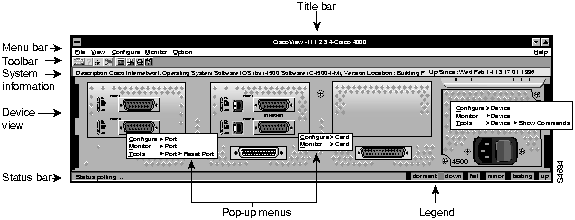
The main window consists of the following elements:
Depending on the device capabilities, several applications are available under an Admin menu.
Table 2-21 : CiscoView File Menu Items
| Item | Explanation |
|---|---|
| Open Device | Display the back panel of a new device |
| Open Previous | Review a list of devices that you have already displayed without specifying the IP address or other information |
| Print the physical view of the device | |
| Printer Setup | Set printer options |
| Exit | Exit CiscoView |
Table 2-22 : CiscoView View Menu Items
| Item | Explanation |
|---|---|
| Front View | Display the front panel of a device on selected devices only |
| Rear View | Display the back panel of a device |
| Refresh | Refresh the current display by checking that all information is current |
| View 50% | Reduce the display of the main panel by 50 percent |
Table 2-23 : CiscoView Configure Menu Items
| Item | Explanation |
|---|---|
| Device | Open an existing or new Configuration Builder file for a specific device |
| Card | Open an existing or new Configuration Builder file for a specific interface card |
| Port:port_conport_tty | Open an existing or new Configuration Builder file for a specific port |
Table 2-24 : CIscoView Monitor Menu Items
| Item | Explanation |
|---|---|
| Device | Open the Health Monitor application for a specific device |
| Card | Open the Health Monitor application for a specific interface card |
| Port | Open the Health Monitor application for a specific port |
Table 2-25 : CiscoView Options Menu Items
| Item | Explanation |
|---|---|
| Show Toolbar | Display or hide the toolbar to access shortcut commands |
| Show System Information | Display or hide system information |
| Show Legend | Display or hide the legend |
| Properties | Set various operating characteristics, including polling frequency, retries, timeout interval, MIB descriptors, and read-write community string |
The Admin menu only appears on specific devices that have administrative option features. Refer to online help for more information.
Table 2-26 : CiscoView Help Menu Items
| Item | Explanation |
|---|---|
| Contents | Open the CiscoView help system table of contents (includes currently loaded device and application help files) |
| Using Help | Learn how to use the online help system |
| Using CiscoView | Open the CiscoView help file |
| About CiscoView | Display CiscoView software release, device type and device software version, and copyright information |
Context-sensitive online help provides you with step-by-step instructions on how to use CiscoWorks Windows applications. The online help system also provides a glossary and keyword search capability.
cs-ciscoworks@cisco.com
or
bug-doc@cisco.com
.
Each dialog box has a Help button. Select the Help button to open a help window describing the purpose of the dialog box and the procedures to complete the tasks that are specific to the dialog box. Links to overview material and related information may also be available, depending on the dialog box information requirements.
F1 Key and Context-Sensitive Help
Select a data-entry field in a Configuration Builder dialog box; then press the F1 key to open a context-sensitive help window with information about the selected field. The Health Monitor and Show Commands applications provide F1 key functionality for general dialog box or tab information only. In CiscoView, press the F1 key while the mouse pointer is positioned over a device to view information about that device type.
Help Window Menu and Button Bars
Each help window has a menu bar and a button bar. The menu bar provides standard Microsoft Windows help functions for printing help topics, copying and pasting text from help topics, making online notes about particular help topics, and placing bookmarks.
The button bar provides the following buttons:
Many help windows have Overview and See Also buttons in the help window topic caption area. You can select the Overview button to obtain background information for the procedure described in the current help window. Select the See Also button to view a list of related topics and go directly to those topics from the current help window.

|
Copyright 1988-1996 © Cisco Systems Inc.