
Table of Contents
Upgrading Cisco 4500 Memory
Upgrading Cisco 4500 Memory
Cisco Product Numbers: MEM-NP8F-P=, MEM-NP16S-P=, MEM-NP32M-P=, and 17-2062-01 (ROM Monitor 5.1)
This publication describes the upgrade and replacement for the main, shared, Flash, and ROM monitor memory for the Cisco 4500. Read this entire publication before upgrading your system. This publication contains the following sections which step you through the upgrade procedures:
When upgrading Flash memory, a Trivial File Transfer Protocol (TFTP) file service must be available, with the desired Internetwork Operating System (IOS) software image---Version 10.1 or later---available on the TFTP file server. These files can then be downloaded into the upgraded Flash memory using TFTP. Consult with your network administrator regarding availability. The system will not be fully functional without the system software and running configuration. Consult the appropriate IOS software publication or Cisco Connection Documentation CD-ROM for TFTP procedures.
Note One upgraded router can serve as a TFTP server for other upgraded routers.
Figure 1 shows the front view of the Cisco 4500. The rear label reads Cisco 4500.
Figure 1 Cisco 4500 Front View
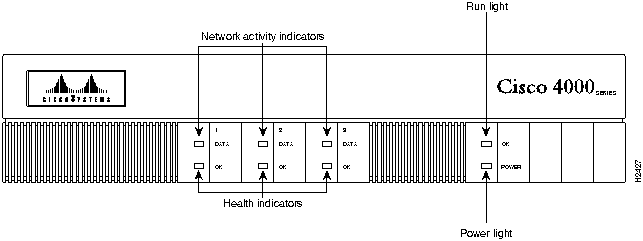
Table 1 lists the Cisco 4500 processor and memory specifications:
Table 1 Cisco 4500 Processor and Memory Specifications
| Processor |
100-MHz IDT Orion RISC(1) |
| Main Memory (DRAM)(2) |
8 or 32 MB |
| Shared Memory (DRAM) |
4 or 16 MB |
| Flash Memory |
4, 8, 16, 32, or 64 MB |
| Nonvolatile RAM |
128 or 512 KB |
| Boot ROM(3) |
128 to 512 KB |
| Boot Flash |
4 to 16 MB |
- (1)
- The Orion microprocessor is based on the MIPS R4400 and is pin-compatible.
- (2)
- DRAMDynamic random access memory
- (3)
- ROMRead-only memory
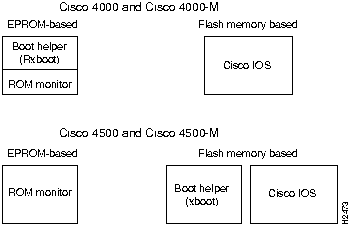
The Cisco 4500 memory systems (see Figure 2) have the following functions:
- Main memory---Stores the running configuration and routing tables. The Internetwork Operating System (IOS) software executes from main memory.
- Shared memory---Used for packet buffering by the router's network interfaces.
- Nonvolatile memory---Stores the system configuration file and the virtual configuration register.
- Flash memory---Stores the operating system software image and the boot helper software. The boot helper image allows you to boot the router when Flash memory does not contain a valid system image.
- EPROM-based memory---In the Cisco 4500, only the ROM monitor image is EPROM-based. The ROM monitor permits you to boot the IOS image from Flash memory if a boot helper image is not present in boot Flash memory.
Figure 2 Cisco 4000 Series Memory Systems and Software Images

Warning To ensure your safety and the safety of others, before working on the router, be sure the power is OFF and the power cord unplugged.
 Caution To avoid damaging ESD-sensitive components, before opening the chassis, be sure you have discharged all static electricity from your body. Before performing procedures described in this publication, review the following sections: "Safety Recommendations" and "Safety with Electricity."
Follow these guidelines to ensure general safety:
- Keep the chassis area clear and dust-free during and after installation.
- Put the removed chassis cover in a safe place. Keep tools away from walk areas where you or others could trip over them.
- Do not wear loose clothing that could get caught in the chassis. Fasten your tie or scarf and roll up your sleeves.
- Wear safety glasses when working under any conditions that might be hazardous to your eyes.
- Do not perform any action that creates a potential hazard to people or makes the equipment unsafe.

Warning Before working on equipment that is connected to power lines, remove jewelry (including rings, necklaces, and watches). Metal objects will heat up when connected to power and ground and can cause serious burns or can weld to the terminals.
Follow these guidelines when working on equipment powered by electricity:
- Locate the emergency power-off switch in the room in which you are working. Then, if an electrical accident occurs, you can act quickly to shut the power OFF.
- Before working on the system, turn OFF the power and unplug the power cord.
- Disconnect all power before doing the following:
- Installing or removing a chassis
- Working near power supplies
- Performing a software upgrade
- Never assume that power is disconnected from a circuit. Always check.
- Do not work alone if potentially hazardous conditions exist.
- Look carefully for possible hazards in your work area, such as moist floors, ungrounded power extension cables, and missing safety grounds.
- If an electrical accident occurs, proceed as follows:
- Use caution; do not become a victim yourself.
- Turn OFF power to the system.
- If possible, send another person to get medical aid. Otherwise, assess the victim's condition and then call for help.
- Determine if the person needs rescue breathing or external cardiac compressions; then take appropriate action.
Electrostatic discharge (ESD) can damage equipment and impair electrical circuitry. It occurs when electronic printed circuit cards are improperly handled and can result in complete or intermittent failures.
Always follow ESD prevention procedures when removing and replacing cards. Ensure that the chassis is electrically connected to earth ground. Wear an ESDpreventive wrist strap, ensuring that it makes good skin contact. Connect the clip to an unpainted chassis frame surface to safely channel unwanted ESD voltages to ground. To properly guard against ESD damage and shocks, the wrist strap and cord must operate effectively.
If no wrist strap is available, ground yourself by touching the metal part of the chassis.
The following tools are required for the main, shared, Flash, and ROM monitor memory removal and upgrade procedures:
- ESD cord and wrist strap
- Screwdrivers, Number 1 and Number 2 Phillips
In addition, the ROM monitor device upgrade requires the following:
- EPROM removal tool or small flat-blade screwdriver
You must open the router chassis to gain access to the router's internal components: the network processor modules, boot ROMs, and jumpers.
Refer to the section "Required Tools" for the tools needed for the following procedures.

Warning Hazardous voltages may exist in or near the power supply, so use extreme caution when working near the power supply. Before starting any of these procedures, turn off power to the system, unplug the power cord, disconnect any cables at the ports, and connect your ESDpreventive wrist strap.
Follow these steps to remove the component tray:
- Step 1 Turn OFF the system power.
- Step 2 Put on your ESD-preventive wrist strap.
- Step 3 Remove all network and power cables.
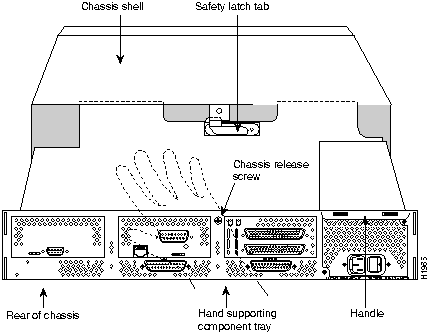
- Step 4 Loosen the (nonremovable) screw in the back of the chassis, labeled Chassis release screw in Figure 3.
- Step 5 Slide the component tray out of the chassis shell while facing the chassis rear panel, pulling the handle on the right side of the chassis until the safety latch catches. (See Figure 3.)
 Warning Before releasing the safety latch, support the component tray from underneath, either on your work surface or with your hands, to prevent personal injury. (See Figure 3.)
Figure 3 Supporting the Component Tray During Removal
- Step 6 While supporting the component tray with one hand, push down on the safety latch tab while pulling out on the component tray.
- Step 7 Set the component tray on your work surface.
Proceed to the section "Removing Network Processor Modules."
If you are replacing shared memory single in-line memory modules (SIMMs), you must first remove the network processor modules. Follow the steps in this section to remove a network processor module.

Caution Some network processor modules are mounted to the rear of the chassis with two external screws. On modules with external rear mounting screws, which include the Fiber Distributed Data Interface (FDDI) module, these screws must be removed before the module can be safely lifted out of the chassis, otherwise damage to the module will occur. Other types of modules may not have the two external rear mounting screws attached to the chassis.
- Step 1 With the component tray in front of you (as shown in Figure 4), remove the module mounting screw from the top end of the network processor module, and the two external rear mounting screws (not shown) if the module has them, and set the screws aside.
Figure 4 Cisco 4500 Component Tray

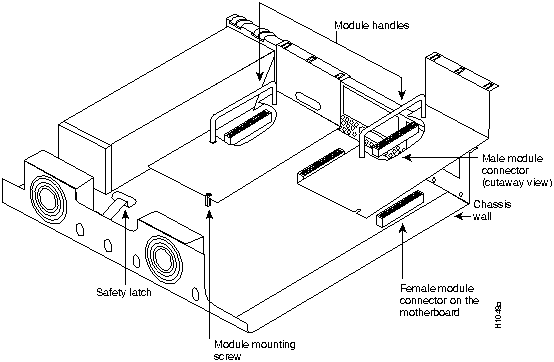
- Step 2 To lift the module out of its connector after removing the mounting screws, grasp the network processor module handle and pull straight up. (See Figure 5.)
 Caution Do not wiggle the handle when handling the network processor module, and do not exert any side-to-side pressure, because the handle might work loose and damage the network processor module.
Figure 5 shows the network processor and connector locations.
Figure 5 Network Processor Module Locations
There are two dynamic random-access memory (DRAM) systems in Cisco 4000 series routers. One is the shared memory, which is the interface that the network processor modules deposit data to or transmit data from, and the second is the primary or main memory, which is reserved for the CPU. The Cisco 4500 ROM monitor is stored in an EPROM device on the motherboard. (See Figure 6.) In addition, the Cisco 4500 has two Flash memory systems: one for the IOS software image and one for the boot helper image. (See Figure 2.)

Caution To avoid damaging ESD-sensitive components, observe all ESD precautions. To avoid damaging the underlying system card, avoid excessive force when removing or replacing SIMMs.
The Cisco 4500 main memory upgrade requires replacing the main memory configuration of 8 MB (two 4 MB SIMMs) with two 16 MB SIMMs.
The Cisco 4500 shared memory upgrade permits you to replace the shared memory SIMM with one 16 MB SIMM.
Upgrading the Cisco 4500 Flash memory requires replacing or adding to the Flash memory configuration of 4 MB with 8, 16, 32, or 64 MB of Flash memory. Figure 6 shows the memory component and jumper locations in the Cisco 4500.
Figure 6 Cisco 4500 Memory Component Locations
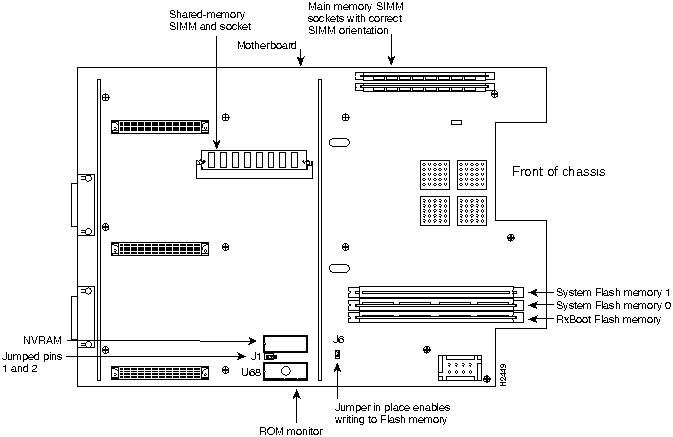
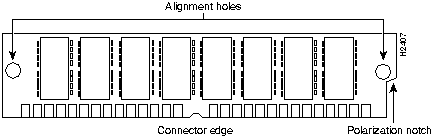
Figure 7 shows the polarization notch and locations of the alignment holes on a main memory SIMM card. The main memory SIMM cards are installed with the connector edge down and the component side facing in, as shown in the upper right of Figure 6.
Figure 7 Cisco 4500 Main Memory SIMM
Follow these steps to remove main memory SIMMs:
- Step 1 Put on an ESD-preventive wrist strap.
- Step 2 On the motherboard, locate the main memory SIMM card sockets shown in the upper right corner of Figure 6.
 Caution Handle SIMMs by the card edges only. SIMMs are ESD-sensitive components and can be damaged by mishandling.
- Step 3 Remove one SIMM at a time, beginning with the SIMM farthest from the edge of the motherboard.
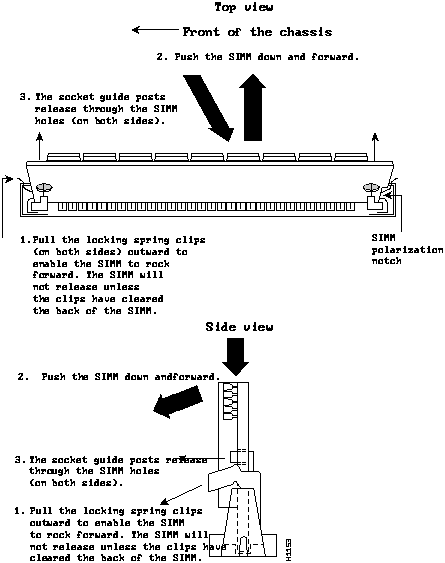
- Step 4 To lift the SIMM out of its socket, pull the locking spring clips on both sides outward and tilt the SIMM free of the clips. (See Figure 8.)
Figure 8 Removing Main Memory SIMMs
- Step 5 Hold the SIMM by the edges with your thumb and index finger and lift it out of the socket. Place the removed SIMM in an antistatic bag to protect it from ESD damage.
- Step 6 Repeat steps 2 through 5 for each main memory SIMM card.
Proceed to the section, "Installing Main Memory SIMMs."
Follow this procedure to install main memory SIMMs.
- Step 1 Put on an ESD-preventive wrist strap.
- Step 2 On the motherboard, locate the main memory SIMM card sockets shown in the upper right corner of Figure 6. All of the sockets should be empty. If not, follow the steps in the section "Removing Main Memory SIMMS."
 Caution Handle SIMMs by the card edges only. SIMMs are ESD-sensitive components and can be damaged by mishandling.
- Step 3 SIMMs are manufactured with a polarization notch to prevent them from being installed backward. Hold the SIMM with the polarization notch on the right and the component side away from you with the connector edge at the bottom. (See Figure 7.)
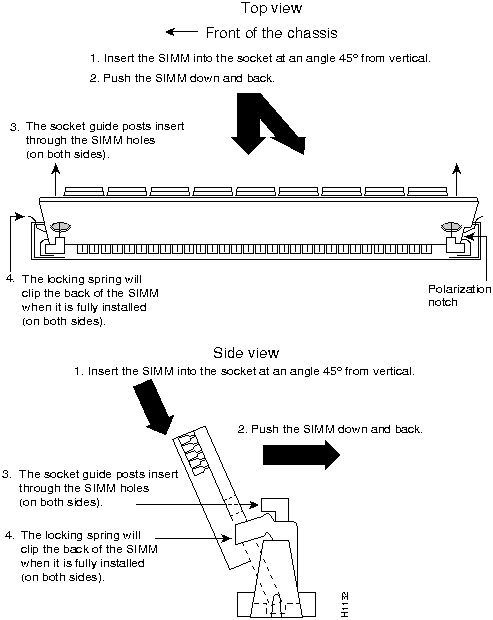
- Step 4 Beginning with the SIMM nearest the edge of the motherboard, insert the main memory SIMM card at a 45-degree angle and rock it into its vertical position (see Figure 9), using the minimum amount of force required. When the SIMM is properly seated, the socket guide posts will insert through the alignment holes, and the connector springs will click into place.
- Step 5 Ensure that each SIMM is straight and that the alignment holes (as shown in Figure 7) line up with the plastic socket guides on the socket.
Figure 9 Installing Main Memory SIMMs

Caution You will feel some resistance, but do not use excessive force on the SIMM and do not touch the surface components to avoid damaging them.
- Step 6 Repeat steps 2 through 5 for each main memory SIMM.
If you are done with all SIMM replacement procedures, proceed to the section "Replacing Network Processor Modules."
Follow this procedure if you are replacing the shared memory SIMMs:
- Step 1 Unplug the chassis power cord and network connections.
- Step 2 Put on an ESD-preventive wrist strap and ensure that it makes good contact with your skin. Connect the equipment end of the wrist strap to the metal back plate of the chassis, avoiding contact with the connectors.
- Step 3 Remove the chassis cover as described in the section "Accessing the Router Internal Components."
- Step 4 Remove and safely store all the network processor modules present as described in "Removing Network Processor Modules" for later reinstallation.
- Step 5 On the motherboard, locate the shared memory SIMM card socket shown on the left of the motherboard as shown in Figure 6.
- Step 6 Turn the chassis so that the chassis rear is closest to you.
- Step 7 The SIMMs are held in place at each end by small metal spring clasps. To remove a shared memory SIMM, push the two metal clasps apart. Angle the SIMM upward and pull it out.
 Caution Do not exert pressure on the components on the SIMM surface because it might be damaged. The sides of the SIMM must clear the metal clasps before the SIMM can be safely removed.
- Step 8 Place the removed SIMM in an antistatic bag to protect it from ESD damage.
- Step 9 Repeat steps 7 and 8 for each SIMM.
- Step 10 Proceed to the section "Inserting Shared Memory SIMMs."
Follow this procedure to insert shared memory SIMMs:
- Step 1 Unplug the chassis power cord and network connections.
- Step 2 Put on an ESD-preventive wrist strap, ensuring that it makes good skin contact. Connect the equipment end of the wrist strap to the metal back plate of the chassis, avoiding contact with the connectors.
- Step 3 Remove the chassis cover as described in the section "Accessing the Router Internal Components."
- Step 4 On the left of the motherboard (as aligned in Figure 6), find the shared memory SIMM card socket locations. All the sockets should be empty. If not, remove the shared memory SIMMs following the procedures in the section "Removing and Replacing Shared Memory SIMMs."
- Step 5 Turn the chassis so that the side with the shared memory SIMM cards is closest to you.
 Caution Handle SIMMs by the card edges only. SIMMs are sensitive components and can be shorted by mishandling.
- Step 6 SIMMs are manufactured with a polarization notch to prevent them from being installed backward. Hold the SIMM with the connector edge at the bottom, component side facing you, and the polarization notch on the left. (See Figure 10.)
Figure 10 Inserting Shared Memory SIMMs
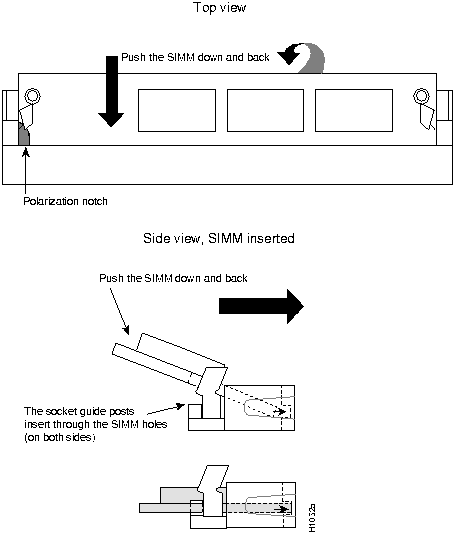
- Step 7 To insert a SIMM, angle it into position, then carefully push down and back on the edges, holding each edge so that it securely snaps in place. (See Figure 10.) When it snaps into place, the two metal clips fit over the edge of the SIMM, and hold the SIMM horizontally.
 Caution SIMMs can be damaged by rough handling or ESD. Also avoid damaging the SIMM socket with rough handling.
- Step 8 Check that the SIMM is straight and that the holes are aligned with the socket guide posts on the socket. (See Figure 10.)
If you are done with all SIMM replacement procedures, proceed to the section "Replacing Network Processor Modules."
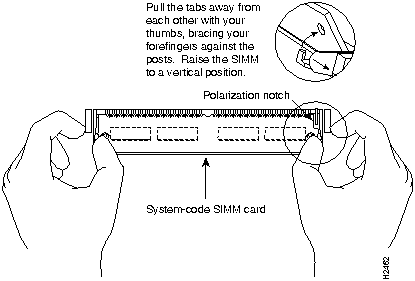
The boot helper image (xboot image) is stored in Flash memory on the Cisco 4500. Follow these procedures to replace the 4 MB SIMM with a 16 MB SIMM. (See Figure 11.)
Figure 11 Removing the Boot Helper Flash Memory SIMM
- Step 1 Put on an ESD-preventive wrist strap.
- Step 2 On the lower right corner of the Cisco 4500 motherboard, locate the SIMM card socket marked xboot memory. (See Figure 6.)
 Caution Handle SIMMs by the card edges only. SIMMs are ESD-sensitive components and can be damaged by mishandling.
- Step 3 To lift the SIMM out of its socket, pull the locking spring clips on both sides outward and tilt the SIMM free of the clips. (See Figure 11.)
Proceed to the section "Installing Flash Memory SIMMs."
Upgrading system Flash memory is done by adding a second SIMM to the empty Flash memory socket. If upgrading the Cisco 4500 xboot Flash memory, you replace the 4 MB component with a 16 MB component.
Follow these steps to add Flash memory SIMMs while referring to Figure 6 for the SIMM locations.
- Step 1 On the motherboard, locate the Flash memory SIMM sockets shown in the lower right corner of Figure 6.
 Caution Handle SIMMs by the edges only. SIMMs are ESD-sensitive components and can be damaged by mishandling.
- Step 2 SIMMs are manufactured with a polarization notch to prevent them from being installed backward. Hold the SIMM with the polarization notch on the right and the component side away from you with the connector edge at the bottom.
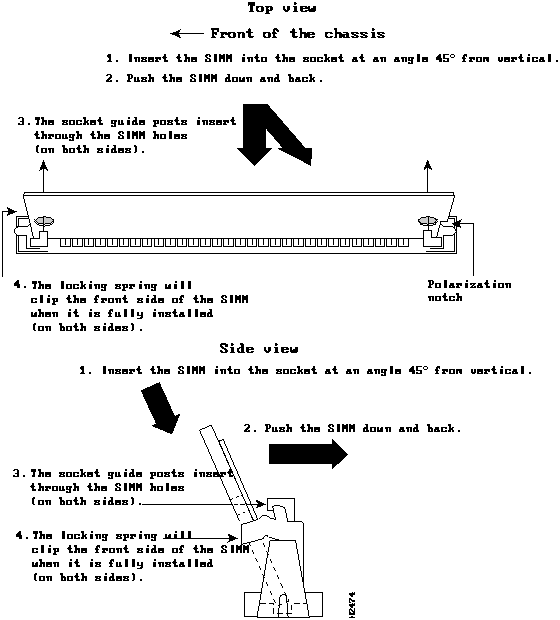
- Step 3 Using Figure 12 as a guide, insert the Flash memory SIMM at a 45-degree angle and rock it into its vertical position in socket location U114. (See Figure 6.) When the SIMM is properly seated, the socket guide posts will insert through the alignment holes, and the connector springs will click into place. Use the minimum amount of force required.
Figure 12 Inserting Flash Memory SIMMs

Caution You will feel some resistance, but do not use excessive force on the SIMM and do not touch the surface components to avoid damaging them.
- Step 4 Check the alignment of each SIMM to make sure that it is straight and that the alignment holes are lined up with the plastic tabs on the socket.
If you are finished with all memory upgrade procedures, proceed to the section "Replacing Network Processor Modules."
The ROM monitor is stored in an EPROM device on the Cisco 4500 at location U68. (See Figure 6.) Follow these procedures to replace the ROM monitor EPROM. Two versions of the label of the ROM monitor EPROM are shown in Figure 13.
Figure 13 Cisco 4500 ROM Monitor Memory Devices
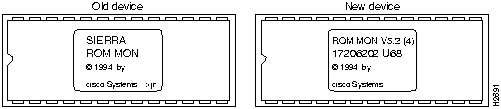
To upgrade the ROM monitor, replace the old EPROM labeled SIERRA ROM MON with the new EPROM labeled C4500 ROM MON 5.1.
- Step 1 Open the chassis and expose the ROM monitor EPROM following the procedures in the section "Accessing the Router Internal Components" and "Removing Network Processor Modules."
- Step 2 With the ROM monitor EPROM in location U68 exposed (see Figure 6), gently extract the old EPROM with an EPROM extraction tool or a small flat-blade screwdriver and set the old ROM monitor EPROM aside.
- Step 3 Insert the new ROM monitor EPROM in the empty socket in the orientation shown in Figure 6, being careful not to crush any of the bottom pins. To straighten out a bent pin, use needlenose pliers. Align the notch in the new ROM monitor EPROM with the notch in the ROM socket, ignoring the orientation of the label.
 Caution The notch on the EPROM must match the notch on the socket on the card. Installing the components backward will damage them.
Proceed to the section "Replacing Network Processor Modules."
Follow these steps to replace a network processor module:
- Step 1 Hold the network processor module by its handle, align it with the grooves in the chassis (not shown) and over its connector, and push the network processor module lightly against the chassis wall. (See Figure 5.)
- Step 2 Gently, without bending the connector pins, push the network processor module into place, inserting the male network processor module connector into the female network processor module connector on the motherboard.
- Step 3 Replace the module mounting screw in its place on the end of the network processor module. (See Figure 5.)
- Step 4 If the module requires external rear mounting screws to attach to the chassis rear, replace the screws at this time.
 Caution Do not overtorque the screw. The network processor module or the underlying motherboard could be damaged. The maximum screw torque is 7 inch-lb.
Follow these steps to replace the component tray in the chassis shell:
- Step 1 Reinsert the component tray into the shell, pushing on the back of the tray while at the same time pressing on the chassis release screw (as shown in Figure 3) with the thumb of your right hand.
- Step 2 Retighten the chassis release screw.
Test your installation by rebooting the system.When you power up a system in which one or more of the boot ROMs was incorrectly inserted, the system will not boot into the ROM monitor or the operating system mode.
If you suspect that your boot ROMs were inserted incorrectly, reopen the chassis, locate the affected boot ROM and remove it, straighten its pins, and then reinsert the boot ROM and try booting again.
This completes Upgrading Cisco 4500 Memory.

Copyright 1988-1995
©
Cisco Systems Inc.



